
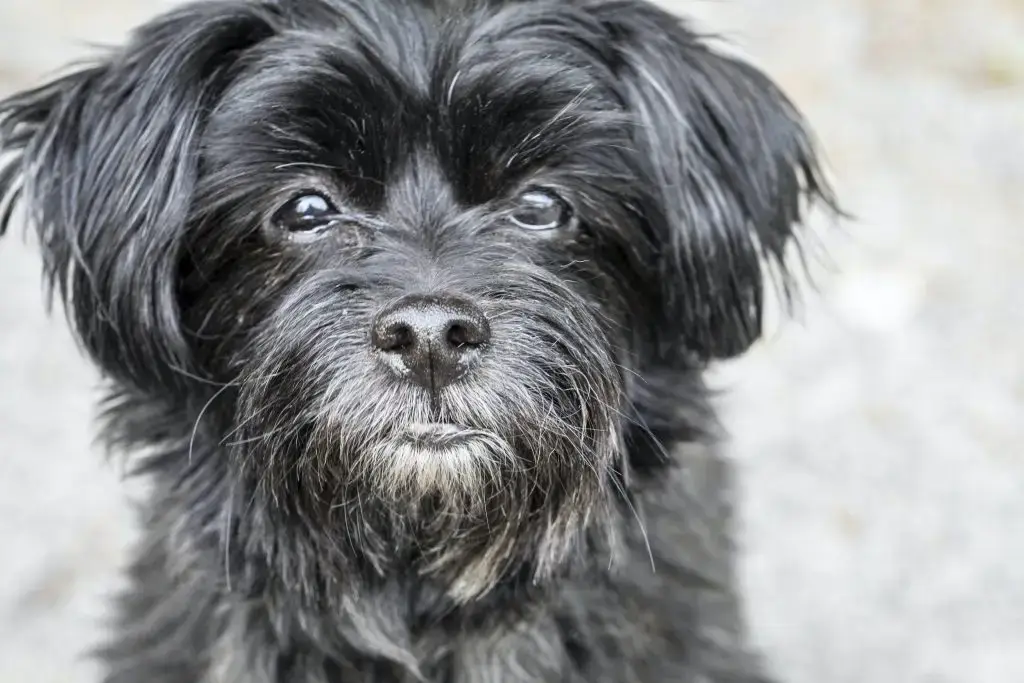
The Affenpinscher is a very small dog with a very large opinion of itself. Owners describe living with one as less like keeping a toy breed and more like sharing a house with a small, bearded, extremely confident person who has decided the two of you are equals.
This covers what the breed is actually like day to day — temperament, coat, barking, the health issues that come with a flat face, and who should think twice.
Why is the Affenpinscher called the monkey dog?
The name is German. Affe means monkey and Pinscher means terrier — so the breed name translates almost literally to “monkey terrier,” and both monkey dog and monkey terrier are still in common use.
It is a description of the face, not the behaviour. The Affenpinscher has a short muzzle, a prominent brow, dark round eyes set wide, and a fringe of coarse whiskers, and the combined effect genuinely does read as simian. The expression is the reason most people fall for the breed.
They were developed in Germany as ratters — small enough to work kitchens, stables and shops, game enough to take on prey that could fight back. That job description explains almost everything about the temperament.
Affenpinscher temperament: what they are actually like
Confident, curious, comic, and completely unaware of their own size. The breed is often described as playful, charming and a little mischievous, and every one of those words is doing real work.
The terrier heritage is not decorative. An Affenpinscher will stand its ground against a dog five times its weight, investigate anything that moves, and treat a closed door as a problem to be solved. They bond hard to their people and are frequently described as more entertaining than obedient.
They are intelligent but independent-minded. Training works with consistency, short sessions and positive reinforcement; it does not work by repetition alone, and it does not work at all if the dog decides the exercise is beneath it.
Are Affenpinschers good with children?
They can be a good family dog, but interactions with young children should always be supervised — and the reason is the dog’s safety as much as the child’s. At 7 to 10 pounds this is a breed that can be seriously injured by an ordinary accident, and a small dog that has been handled roughly learns to defend itself.
Do Affenpinschers shed?
No. Affenpinschers do not shed much. The coat is harsh, dense and wiry rather than soft, and it holds onto loose hair instead of dropping it.
As with most low-shedding breeds, that is a trade, not a saving. Hair that stays in the coat has to be taken out by hand. Plan on brushing at least twice a week, and professional grooming every four to six weeks to keep the harsh texture and the characteristic face furnishings in shape.
No dog is truly hypoallergenic, but a low-shedding wiry coat puts less dander into the air than a coat that blows out seasonally.
How big do Affenpinschers get?
9 to 12 inches tall and 7 to 10 pounds. Small enough for apartment living, sturdy enough not to feel fragile in the way some toy breeds do — but still a dog that can be stepped on, sat on, or hurt in a fall from furniture.
How much exercise do they need?
Moderate. Playtime and short walks cover it; this is not a breed that needs an hour of hard running. Mental work matters more than mileage — puzzle feeders, training games and anything that lets them problem-solve will do more for an Affenpinscher than another lap of the block.
Be realistic about the terrier instinct outdoors. Small prey animals are interesting to this dog, and a securely fenced yard is worth more than good intentions.
Do Affenpinschers bark a lot?
They are alert and they will tell you about it. A dog bred to work vermin and guard a shop is a dog with opinions about visitors, deliveries and unexpected noises. It is manageable with early training, but expect a watchdog in a 9-pound package rather than a quiet lapdog.
Affenpinscher health problems
The flat face — brachycephalic airway syndrome
The Affenpinscher is a brachycephalic breed, and brachycephalic airway syndrome is the health issue that matters most. A shortened muzzle means a compressed airway, and that has practical consequences every day: reduced tolerance for heat, laboured breathing on exertion, snoring, and higher anaesthetic risk.
Practically — do not exercise one hard in hot weather, never leave one in a warm car, use a harness rather than a collar so nothing presses on the throat, and treat noisy or laboured breathing as a veterinary matter rather than a breed quirk.
Other conditions the breed is prone to
- Patellar luxation — slipping kneecaps, common across toy breeds
- Hip dysplasia
- Mitral valve disease — a heart condition worth annual listening for as the dog ages
- Cataracts
A breeder worth buying from will screen for these and will raise them before you ask.
How long do Affenpinschers live?
12 to 15 years. A long life for a dog, and worth planning for honestly — this is a fifteen-year commitment, not a ten-year one.
Affenpinscher mixes
Because the breed is rare, most dogs sold as Affenpinscher crosses are mixed with other small terriers or toy breeds, and the results vary enormously. A mix may inherit the wiry coat and the low shedding, or it may not. It may inherit the shortened muzzle and the breathing issues that come with it, or it may not.
If low shedding is the reason you are buying, a mix is not a guarantee of it. Meet the dog, not the label.
Is an Affenpinscher right for you?
Probably yes if you want a small dog with a genuine personality, you find stubbornness funny rather than frustrating, you are fine with regular grooming, and a watchful dog that barks at the door suits your household.
Probably not if you want a biddable dog that does as it is told, you have very young children, you live somewhere hot without reliable air conditioning, or you assumed low shedding meant low grooming.
Keeping a small dog findable
Small breeds go missing differently from large ones. They fit through gaps in fencing that look far too narrow, they are quick and low to the ground, and a collar sits on a neck small enough that it can be backed out of or caught and slipped. A stranger who finds a loose 8-pound dog also tends to assume it is a stray and pick it up, which means your dog can be several miles away within the hour.
A microchip is the part that cannot come off. It is a passive RFID tag the size of a grain of rice, implanted between the shoulder blades, carrying one number a scanner can read. It does not track your dog — no battery, no GPS — but it identifies your dog permanently, as long as the number is registered to contact details that are current.
- What a microchip does, and what it cannot do
- Where microchips are placed in dogs, and how they work
- The chances of finding a lost dog after 24 hours
- What to put on your dog’s collar tag
- Look up a microchip number
Register your dog’s microchip with Peeva
Microchip resources
Find the registry by microchip prefix · Look up a microchip number · Universal microchip scanners · Register your pet’s microchip
