
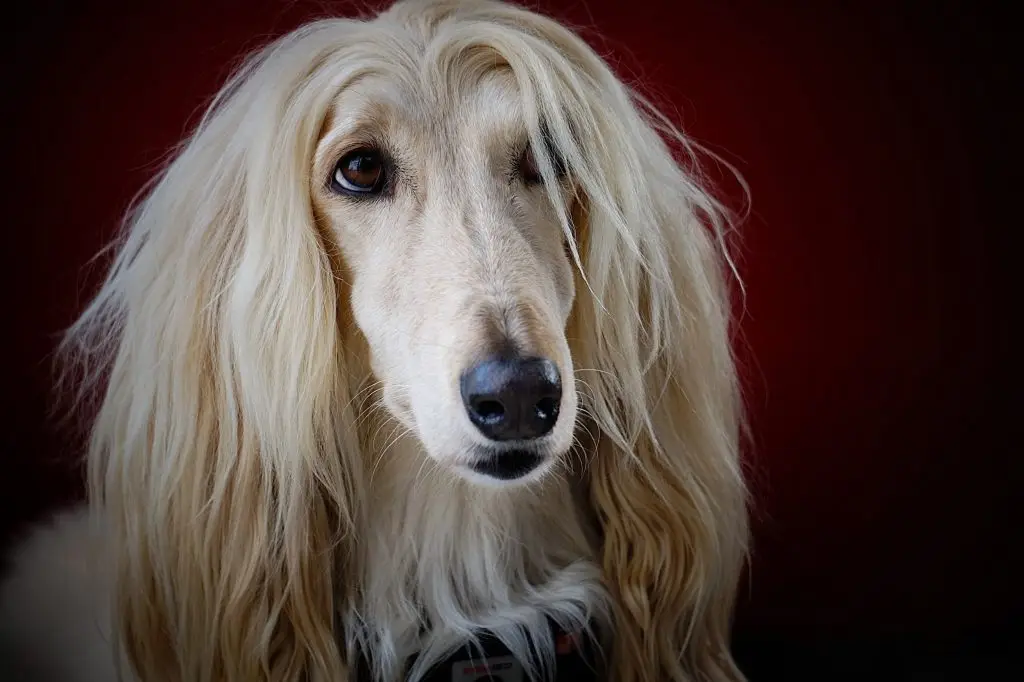
The Afghan Hound is one of the most recognisable dogs alive and one of the most widely misunderstood. Most of what gets written about the breed describes how it looks. Very little of it describes what happens when you bring one home.
This is written for people deciding whether to get one, and for people who already have one and want straight answers about the coat, the recall, and the health problems worth knowing about in advance.
What Afghan Hounds are actually like to live with
The temperament people expect from the photographs is not the temperament they get. Afghans are aloof and dignified with strangers, and genuinely silly with the people they trust. They are frequently described as cat-like, and it is a fair comparison: affectionate on their own terms, uninterested in constant approval, and capable of ignoring you with total composure.
If your idea of a dog is one that watches you for instructions, this is not that dog. An Afghan will hear you, consider it, and make its own decision. Owners who enjoy the breed find this funny. Owners who wanted a retriever find it maddening.
They are typically 25 to 27 inches at the shoulder and 50 to 60 pounds — a large dog with a deceptively light frame under all that coat.
Do Afghan Hounds shed?
No. Afghan Hounds shed very little. The coat is long and fine, closer in texture to human hair than to a typical double coat, and it does not blow out seasonally the way a Labrador or a Husky does.
This is the single most misread fact about the breed. Low shedding is not the same as low maintenance. Hair that does not fall out on your floor is hair that stays on the dog, and hair that stays on the dog mats. What you save in vacuuming you pay back many times over in brushing.
What the coat really costs you
Expect to spend a few hours every week keeping a full coat in condition, plus regular bathing. This is not a brush-while-watching-television commitment. A properly maintained Afghan coat needs sectioning, line brushing down to the skin, and drying after every bath. A matted coat cannot simply be brushed out, and once matting reaches the skin the only humane answer is clipping it off.
Owners realistically have three options, and it is worth deciding which one you are before you buy:
- Full coat, maintained at home. Several hours a week, every week, for the life of the dog.
- Full coat, maintained professionally. Regular appointments, which on a dog this size with this coat length are not cheap.
- A puppy clip. The coat kept short. Far less work, and a perfectly reasonable choice for a pet — though it removes the thing most people bought the breed for.
None of these is wrong. Drifting between them without deciding is what produces a matted dog.
Can an Afghan Hound be trusted off-lead?
For most owners, in most places, no. This is the most important practical fact about the breed and it deserves more space than the grooming does.
Afghans are sighthounds. They were bred to spot movement at a distance across open country and run it down without waiting for a human to catch up. That instinct is intact. Like other sighthounds they have a high prey drive and may kill small animals, and an Afghan in pursuit is moving fast enough, and getting far enough away, that recall stops being a realistic proposition.
The breed also has a reputation for being hard to train, which is only half right. Afghans are not unintelligent — they are independent. In the standard obedience rankings they sit near the bottom, needing more than 80 repetitions to reliably learn a new command. That measures willingness to take instruction, not problem-solving ability.
In practice: a securely fenced yard, a long line in open spaces, and no assumptions. Plenty of Afghans live happy lives never having been off-lead outside a fence.
How much exercise do they need?
At least an hour a day, and it needs to include the chance to actually run. A sighthound walked on a lead for an hour has been walked, not exercised. A large secure space where the dog can open up a few times a week does more for an Afghan than double the mileage on pavement.
Lure coursing and sprint events suit the breed well and give the instinct somewhere legitimate to go.
Health problems worth knowing about
Afghans are not a fragile breed, but they carry a few specific risks and one of them is genuinely urgent for any owner to know.
Anaesthesia sensitivity — tell every vet, every time
Like other sighthounds, Afghan Hounds are sensitive to anaesthesia, because they carry relatively little body fat. Standard dosing protocols assume a body composition this breed does not have. Any competent vet will know this, but do not assume — say it out loud before any procedure, including routine dentals. It is the single most useful thing on this page.
Chylothorax
The breed is notably susceptible to chylothorax, where lymphatic fluid leaks into the chest cavity. It causes breathing difficulty and can progress to lung-lobe torsion, which is a surgical emergency. Laboured breathing or a soft persistent cough in an Afghan is a same-day veterinary call, not a wait-and-see.
Bloat (gastric dilatation-volvulus)
The deep, narrow chest that gives the breed its outline also puts it at risk of bloat, where the stomach distends and can twist. It is rapidly fatal without surgery. Learn the signs — unproductive retching, a hard swollen abdomen, obvious distress — before you need them.
Other conditions to screen and watch for
- Hip dysplasia
- Hypothyroidism
- Eye conditions including cataracts and corneal dystrophy
- Laryngeal paralysis
- Dilated cardiomyopathy
- Allergies and skin conditions
- Cancer
A breeder worth buying from will health-test and will raise these without being prompted.
How long do Afghan Hounds live?
A UK study put life expectancy for the breed at 11.1 years, against an average of 12.7 for purebred dogs and 12 for crossbreeds. That is shorter than many large breeds and worth factoring into the decision honestly.
What an Afghan Hound costs to keep
Purchase price varies enormously by breeder, country and bloodline, and anyone quoting a single figure is guessing. The ongoing cost is more predictable, and for this breed the coat dominates it:
- Grooming — either several hours of your own time per week, or professional appointments on a large long-coated dog.
- Equipment — a proper pin brush, a high-velocity dryer and a grooming table are not optional if you maintain the coat at home.
- Veterinary — standard costs for a 50–60lb dog, plus the screening above.
- Secure fencing — for a dog that cannot be recalled off a chase, this is a genuine line item, not an afterthought.
Is an Afghan Hound right for you?
Probably yes if you want a large, quiet, independent dog with a sense of humour, you have secure outdoor space, and you find coat care satisfying rather than a chore.
Probably not if you want a dog that reliably comes when called, you were hoping for a low-effort coat because the breed does not shed, you have small pets the dog will share space with, or nobody is home to provide an hour a day of real exercise.
Keeping an Afghan Hound findable
Every trait that makes this breed remarkable also makes it hard to recover once it is out of sight. Afghans are fast, independent, and will cover more ground in ten minutes than you can search in an hour. A collar and tag are the first line of defence, and on a long, fine coat they are also the first thing to slip off in undergrowth.
A microchip is the part that cannot fall off. It is a passive RFID tag the size of a grain of rice, implanted between the shoulder blades, carrying one number a scanner can read. It does not track your dog — no battery, no GPS — but it identifies your dog permanently, provided the number is registered to contact details that are current.
- Where microchips are placed in dogs, and how they work
- What a microchip does, and what it cannot do
- The chances of finding a lost dog after 24 hours
- Where lost dogs go at night
- Look up a microchip number
Register your dog’s microchip with Peeva
Microchip resources
Find the registry by microchip prefix · Look up a microchip number · Universal microchip scanners · Register your pet’s microchip
