

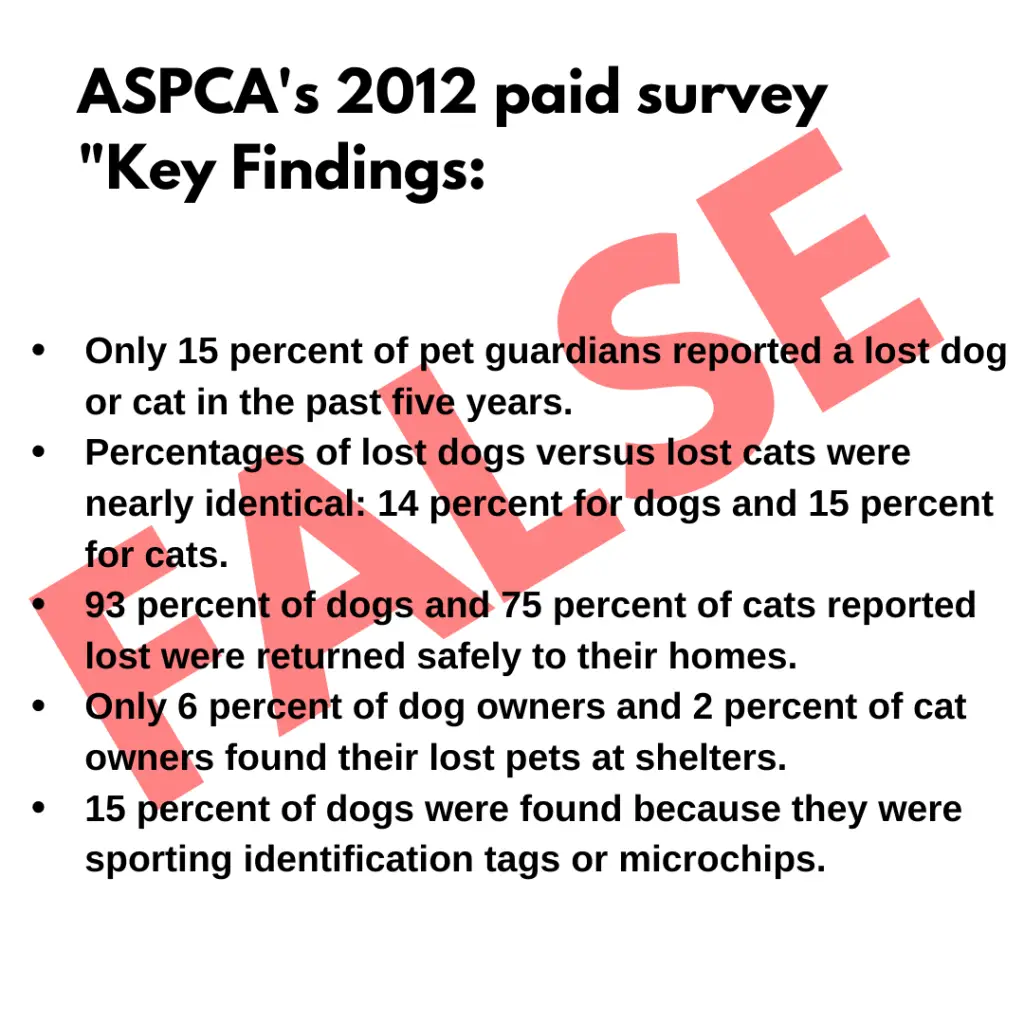
In 2012 the ASPCA published the results of a national telephone survey on lost pets (Weiss, Slater and Lord, Animals, 2012). Its headline findings were that about 15% of households had lost a dog or cat in the previous five years, and that 85% of those pets were recovered — 93% of dogs and 74% of cats. Those numbers were widely repeated, including by VetStreet and the Huffington Post, as “the first published national study on lost pets.”
They were also very different from every earlier source. The American Humane Association had reported that one in three pets goes missing at some point in its life, and the Coalition for Reuniting Pets and Families that fewer than 23% of lost pets are reunited with their owners. A gap that large is worth understanding, because the answer changes what a pet owner should do.
What the 2012 survey measured
The survey was conducted by a third-party research firm dialling random telephone numbers, and it reached 1,015 households. Two design choices explain most of the gap with earlier figures.
The definition of “lost” was deliberately broad. In the authors’ own words, responses “were based on the owner’s concern and belief that the pet was lost and not an objective definition.” A dog that slipped out of the yard and was back within the hour counted as lost and recovered.
Time was not a variable. The survey did not separate pets that were missing briefly from pets that were gone long enough to be reported to a shelter. The authors flagged this themselves: “the specific circumstances under which the pet was considered to be lost would also be useful. This is an area of future research that should be explored.”
Reported versus not reported
That distinction is the whole question. Think of a crowded parking garage: you forget where you parked, press the key fob, follow the sound and drive off. The car was technically out of your possession, but nobody would count it in vehicle-recovery statistics, because it was never reported. Fold every briefly missing pet into the recovered column and the recovery rate will always look reassuring.
The number an owner needs is different: if my pet is gone long enough that I report it to shelters, what are the odds it comes home? The 2012 survey does not answer that. Read as a measure of how often pets wander briefly and return, it is a reasonable study. Read as a measure of how often reported-missing pets are recovered, it can give owners a false sense of security.
Why there is no national figure
There is no national reporting structure for lost pets. Shelters and rescues are not required to record how many animals they take in, adopt out, euthanize or return to owners, and most large welfare organizations publish estimates rather than counts. That is why the same organization can publish 2.7 million and 920,000 as annual euthanasia figures a few years apart, and why owners searching for basic answers — how likely is it my pet will go missing, how likely is it I will find it — find so little.
What Peeva did about it
In 2016 I had the same questions, found the 2012 survey, and could not reconcile it with the earlier sources. So we gathered our own data. Between June 2015 and November 2016 we surveyed 4,048 people in person, qualified 1,356 who had lost a dog or cat, and analysed what happened to 1,409 reported-missing pets. We counted only pets that had actually been reported missing. The abstract, methods, qualification rules and findings are published in full.
1 in 3 dogs and cats in the United States go missing at some point in their lifetimes.
More than 80% of all dogs and cats in the United States that go missing are never found.
Of the 1,409 reported-missing pets in our sample, 86% were never recovered — 96% of cats and 77% of dogs. Those findings match the earlier sources, not the 2012 survey, once the definition of “lost” is held to pets that were actually reported. Read the complete missing-pet study, or the summary on Research & Findings.
Data should drive decisions that save companion animals’ lives. Until shelters and rescues are required to report intakes, reclaims and outcomes, the best any of us can do is measure carefully, define terms honestly, and say what was counted.
If your pet is missing right now
The single most useful thing you can do in the first hour is confirm your pet’s microchip is registered to your current phone number. A chip returns a number; if nothing is attached to that number, a found pet is an anonymous pet.
- Look up a microchip number
- Search the lost and found pets database
- The chances of finding a lost dog after 24 hours
- What a microchip does, and what it cannot do
Register your pet’s microchip with Peeva
Microchip resources
Find the registry by microchip prefix · Look up a microchip number · Universal microchip scanners · Register your pet’s microchip
