
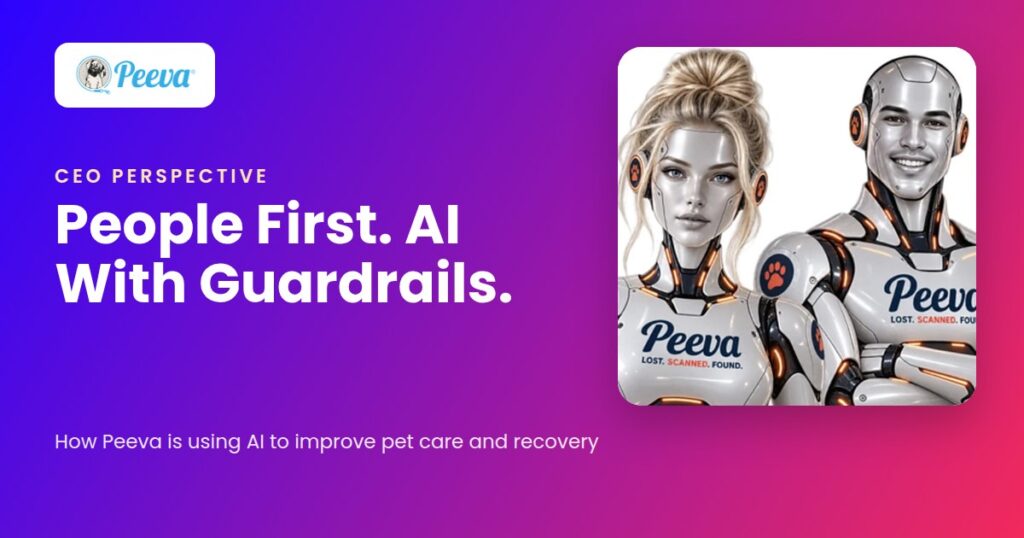
CEO Perspective · AI at Peeva
PEOPLE FIRST.
AI WITH GUARDRAILS.
How Peeva is using artificial intelligence to give our people better tools, provide customers with faster support, and help build a more intelligent future for pet recovery.
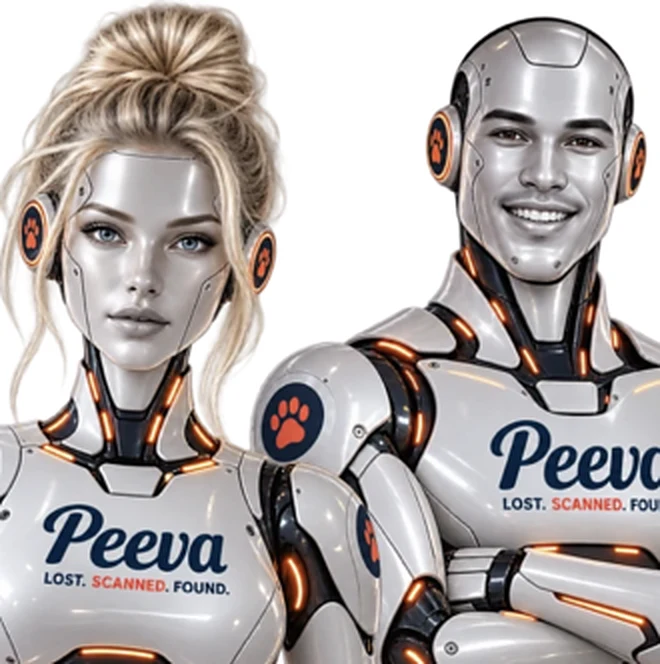
People are the most important asset of any company. AI should make those people more capable—not make them less important.
Technology changes. Business models evolve. Competitive advantages come and go. But organizations are ultimately built by people—their judgment, experience, creativity, empathy, and ability to solve problems when the answer isn’t obvious.
That belief is shaping how we are approaching artificial intelligence at Peeva.
There is an understandable tendency today to talk about AI primarily in terms of automation:
How many tasks can we automate?
How much labor can we eliminate?
How much faster can machines perform work that people currently perform?
I think that framing misses one of the larger opportunities.
The more interesting management question is:
How can AI make good people dramatically more effective at the work that matters?
At Peeva, that’s the question we’re trying to answer.
And it has implications that extend far beyond customer service.
As a company built around permanent pet identification, pet recovery, centralized pet information, and pet medical records, we believe AI has the potential to help us connect information faster, remove administrative friction, improve customer support, and ultimately create better outcomes for pets and the people who love them.
But we’re approaching that opportunity with an important principle:
People first. AI with guardrails.
The Economics of AI Are Really About Human Productivity
There is now meaningful academic evidence supporting this approach.
Researchers Erik Brynjolfsson, Danielle Li, and Lindsey Raymond studied the introduction of a generative AI assistant across 5,179 customer-support agents.
They found that access to the technology increased productivity—measured by issues resolved per hour—by approximately 14% on average. The benefits were considerably greater among less experienced workers.
Perhaps more interestingly, the researchers found evidence suggesting AI helped disseminate some of the practices of more capable and experienced employees throughout the organization.
Read the research from the National Bureau of Economic Research →
To me, that’s one of the most interesting implications of AI for business.
AI isn’t valuable simply because a machine can perform a task.
Its greater value may come from making organizational knowledge more accessible, reducing unnecessary friction, and allowing people to spend more of their limited time on activities where human judgment creates the greatest value.
Consider customer service.
A tremendous amount of time can be consumed by necessary but repetitive work:
- Searching for information
- Answering common questions
- Navigating records
- Documenting conversations
- Routing requests
- Determining which system contains the right information
- Figuring out what should happen next
Those activities matter.
But they’re rarely why you hire talented people.
That’s where Grace comes in.

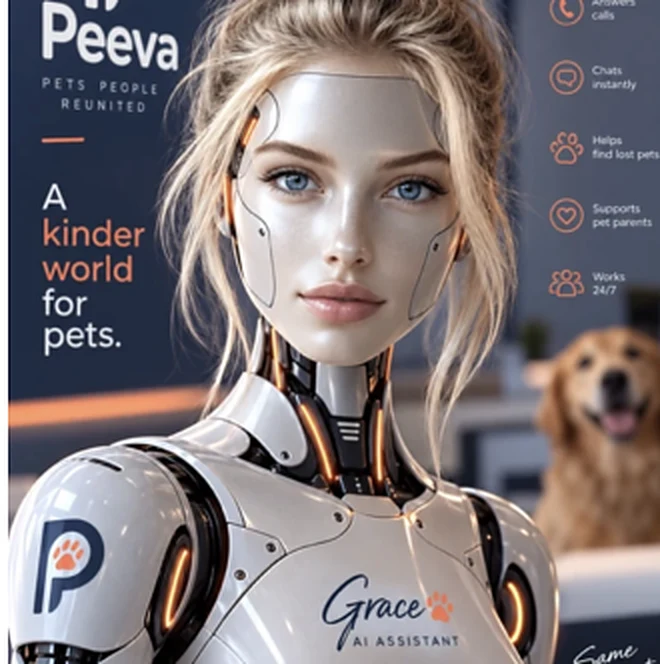
Meet Grace: Peeva’s AI Chat Agent
Hi, I’m Grace.
Peeva’s AI-powered support agent, built to help customers get answers faster while giving our people more time to solve the problems where human judgment matters most.
Grace represents one of our first significant steps toward integrating artificial intelligence into the Peeva customer experience.
Her role is intentionally straightforward.
Grace is designed to help customers find answers to routine questions, navigate Peeva’s services, surface relevant information, gather information needed to resolve a request, and help determine what should happen next.
Strategically, however, the idea is much bigger than a chatbot.
Traditional customer service is largely queue based.
A customer asks a question.
The question enters a queue.
An employee receives it.
That employee determines what information is needed, finds the relevant information, responds to the customer, documents the interaction, and moves to the next request.
Some of those interactions absolutely require a person.
Many don’t.
AI gives us an opportunity to distinguish between the two.
Every appropriate routine interaction Grace can help resolve is time our team can redirect toward situations where a person provides substantially greater value.
And in our business, those situations matter.
Peeva provides 24/7/365 pet recovery support. When someone’s pet is missing, that isn’t simply another support ticket.
There is an anxious person on the other side of that interaction.
That is precisely where we want our people focused.
The objective isn’t to put AI between Peeva and our customers.
The objective is to remove unnecessary friction between our customers and the help they need.
AI With Guardrails
None of this means handing every decision to an algorithm.
In fact, I believe companies implementing AI responsibly need to become increasingly deliberate about identifying where automation should end.
At Peeva, I think about it this way:
-
Automate tasks.
Retrieving information, organizing data, summarizing interactions and handling repetitive workflows.
-
Augment people.
Identifying patterns and helping determine what information may be relevant.
-
Escalate judgment.
Empathy, discretion, verification, accountability and professional judgment stay human.
AI can be extraordinarily effective at retrieving information, identifying patterns, organizing data, summarizing interactions, handling repetitive workflows, and helping determine what information may be relevant.
But there are circumstances where empathy, discretion, verification, accountability, or professional judgment should remain human responsibilities.
That distinction is particularly important in animal health and pet recovery.
The veterinary profession is confronting similar questions as AI enters veterinary workflows. The American Animal Hospital Association has explored emerging applications ranging from administrative automation to medical documentation and, increasingly, AI-assisted pet identification.
AAHA has also documented how AI-powered image recognition is already being used to compare photographs of lost and found animals and surface potential matches.
Read AAHA’s research on AI and lost-pet identification →
That’s very similar to our philosophy at Peeva.
AI should amplify human capability—not eliminate human accountability.
Why AI Matters to Peeva
Grace is important, but she represents the beginning of a much larger opportunity.
Peeva operates at the intersection of historically fragmented parts of the pet-care ecosystem:
- Pet identification
- Pet owners
- Veterinary practices
- Animal shelters and rescues
- Pet medical information
- Lost-pet recovery
- Communication
- Data
Peeva’s central pet registry and Peeva Fetch platform are already designed around the idea that pet identification becomes substantially more useful when information can move securely between the people and organizations that need it.
Our pet medical records platform extends that concept by connecting permanent pet identification with important health information.
Our lost-and-found pet database helps people report and search for missing and found pets.
Our microchip lookup provides another pathway for determining whether an animal’s microchip is registered with Peeva.
And our recovery infrastructure can send lost-pet alerts and notify enrolled pet owners when their pet’s microchip is scanned within Peeva’s connected network.
AI gives us the opportunity to make that infrastructure significantly more intelligent.
From Artificial Intelligence to Recovery Intelligence
Consider what happens when a pet disappears.
There may be a microchip.
There may be photographs.
There may be a veterinary record.
There may be a shelter intake.
There may be a lost-pet report.
There is a last-known location.
There may be subsequent sightings.
There may be multiple descriptions of the same animal written by different people.
There may be hundreds or thousands of potentially relevant records.
Historically, people have been responsible for connecting many of those dots.
Machines are becoming remarkably good at helping us do it.
- Computer vision can compare photographs.
- Language models can interpret inconsistent descriptions.
- Algorithms can evaluate geographic relationships.
- AI can continuously compare new information against existing information.
- And automated systems can notify people when something important changes.
AAHA’s reporting on AI-assisted pet recovery illustrates what becomes possible when image recognition is combined with a large lost-and-found database. In one case highlighted by AAHA, a lost dog’s photograph was matched approximately one minute after the owner submitted a lost report, helping connect records that ultimately contributed to the dog’s reunion.
See how AI is being used to help reunite lost pets →
That technology does not make permanent identification obsolete.
I believe it makes permanent identification more valuable.
The Future Isn’t AI or Microchips
It is easy to think about new technologies as replacements for old ones.
I don’t think that’s the right framework here.
The American Veterinary Medical Association has long emphasized the importance of microchipping as a permanent form of pet identification.
The American Animal Hospital Association similarly supports permanent microchip identification and has advocated for accessible databases, accurate information, universal scanning capabilities, and greater integration across animal-identification systems.
Read AAHA’s recommendations on animal identification and microchipping →
AI doesn’t replace that foundation.
It adds intelligence around it.
A microchip can tell us:
- This is a unique animal.
AI may increasingly help answer:
- Could this photograph be that animal?
- Could these two records describe the same pet?
- Which information is most relevant?
- Where should we search next?
- Who needs to be notified?
- Which case requires immediate human attention?
Put those capabilities together and the question changes.
Instead of simply asking:
“Can we identify this animal?”
We can begin asking:
“How quickly can we get this animal home?”
That’s where I believe this technology becomes particularly compelling.
AI Can Give Our People Superpowers
One of the most interesting implications of the customer-support research is that AI can potentially accelerate the experience curve.
Knowledge that historically took months or years to acquire can increasingly be surfaced when an employee needs it.
Imagine a Peeva team member dealing with a complicated recovery case.
Instead of manually searching multiple sources, the system could eventually help surface the relevant history, organize the information, identify possible connections, summarize what has already happened, recommend the next workflow, and identify where human intervention is required.
The person remains responsible.
But the organization’s knowledge is sitting beside them.
That’s a much more compelling vision of artificial intelligence than simply replacing employees.
It is institutional knowledge becoming available on demand.
Trust Has to Be Built Into the Architecture
There is another reason we’re taking a measured approach.
Peeva deals with information people expect us to protect.
Pet-owner information, microchip records, veterinary information, and recovery data cannot simply become raw material for unrestricted experimentation.
Our existing systems are designed around permission-based access and appropriate controls on how pet information is made available.
Learn more about how Peeva approaches pet-owner confidentiality →
As AI becomes more capable, governance becomes more important—not less.
That means thinking carefully about:
- Privacy
- Security
- Data access
- Human oversight
- Escalation
- Monitoring
- Accuracy
- Accountability
Innovation and responsibility aren’t competing objectives.
For companies that intend to be around for a long time, they’re complementary.
What We’re Building Toward
Grace is the first visible expression of a much broader idea.
Over time, I believe Peeva can continue evolving beyond pet identification and recovery infrastructure toward something larger:
Pet Identity + Recovery Intelligence
Permanent identification remains foundational.
But imagine that permanent identity working intelligently with photographs, medical information, lost-and-found reports, scan events, location information, veterinary systems, shelters, and people.
- AI can help us search.
- It can help us recognize patterns.
- It can help us organize information.
- It can help prioritize potential matches.
- It can automate appropriate alerts.
- It can reduce administrative work.
- It can help our people respond faster.
And eventually, it may help us substantially reduce the time separating a missing pet from the family looking for it.
That is a future worth building.
Explore the future of AI at Peeva →
People First
Every technological transformation creates pressure to chase technology for its own sake.
We’re trying to resist that.
At Peeva, the question won’t simply be:
Where can we use AI?
The better question is:
Where can AI meaningfully improve an outcome for a pet owner, veterinary professional, shelter, employee—or ultimately, a missing pet?
If technology removes repetitive work, improves access to information, reduces response time, or helps our people make better decisions, it deserves serious consideration.
If it simply puts technology between a person and the help they need, it doesn’t.
That’s the guardrail.
Our people remain our greatest asset.
Grace—and the AI capabilities we’re building around her—should make that asset stronger.
People first. Technology in service of people. AI with guardrails.
Because ultimately, success won’t be measured by how much AI we deploy.
It will be measured by how well we serve our customers and how many pets we help get home.
Meet Grace
Faster answers when you need them. Human support when it matters.
Grace is Peeva’s AI-powered support agent, designed to help you find information, navigate Peeva, and get to the right answer faster—with our team ready when you need a person.
AI-powered support. Peeva-powered people.
Related Reading
- AI at PeevaGrace, our guardrails, recovery intelligence and the future of pet identity.
- How Pet Recovery WorksLearn how Peeva’s pet recovery system, lost-pet alerts, microchip scanning, and 24/7 support work together.
- Peeva Fetch: Centralized Pet Identity & Medical RecordsSee how Peeva connects microchip identification with centralized pet information.
- Pet Medical RecordsLearn how a pet’s permanent microchip identity can connect veterinary professionals with important health information.
- Lost & Found Pet DatabaseSearch or report a lost or found pet.
- Microchip LookupCheck whether a pet’s microchip is registered with Peeva.
- Pet Owner ConfidentialityLearn more about Peeva’s approach to pet-owner information and data access.
Sources & Further Research
- Brynjolfsson, E., Li, D., & Raymond, L. Generative AI at Work. National Bureau of Economic Research Working Paper 31161.
- American Animal Hospital Association. How AI Facial Recognition Is Bringing Lost Pets Home.
- American Animal Hospital Association. Animal Identification and Microchipping.
- American Veterinary Medical Association. Microchipping Your Pet.
