
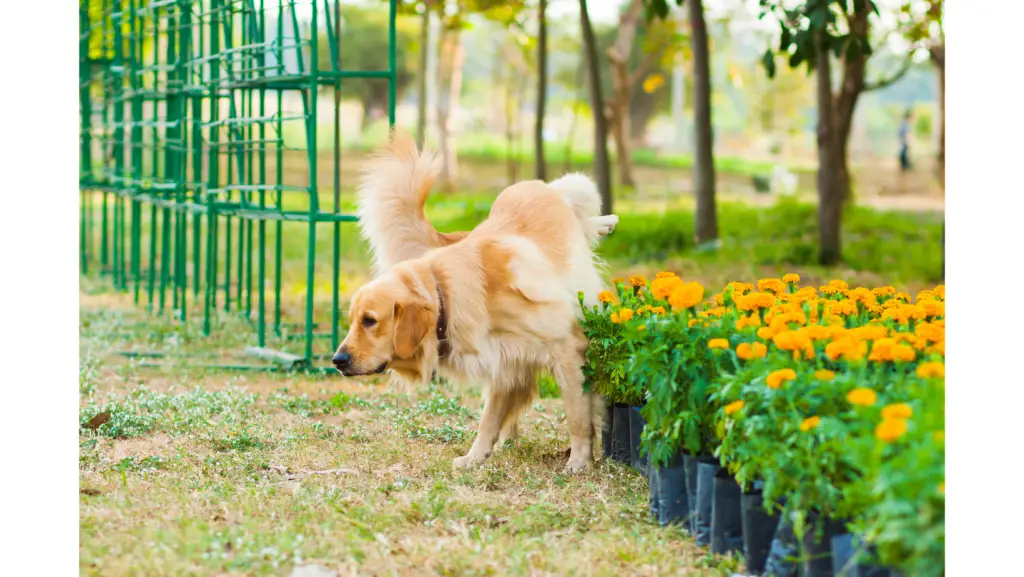
Pet urine smell in a yard is a bacteria problem, not a dirt problem. Urine itself is close to odourless when fresh. What you are smelling is what happens next: bacteria break the urea down into ammonia, and in warm weather that happens fast.
That one fact explains why hosing helps, why bleach does not, and why the smell always comes back in August.
Does male dog urine smell worse than female?
Usually yes, if he is intact — but the reason is behaviour more than chemistry.
An intact male marks. He deposits small amounts on many vertical surfaces — fence posts, planters, the corner of the shed — and testosterone adds odorous compounds to the urine itself. More spots, spread over more surface area, each one feeding bacteria, means more smell overall. Neutering reduces both the marking behaviour and the odour, usually noticeably.
A female typically empties her bladder in one go, in one place. That is less total smell across the yard but a much more concentrated single deposit — which is why yellow lawn burn patches are more associated with female dogs while the general ammonia smell is more associated with intact males.
The short version: intact male, worse smell spread widely. Female or neutered male, less smell but more visible lawn damage in one spot.
Why cat urine is much worse than dog urine
This is not your imagination, and it is not a fair fight. Cat urine contains sulphur compounds that dog urine does not.
Cats produce felinine, a sulphurous compound unique to them. As it degrades it breaks down into 3-mercapto-3-methylbutan-1-ol (MMB) — the thiol responsible for the specific, penetrating smell everyone recognises as cat pee. Crucially, it gets worse over time, not better, as the compound continues to break down.
Cat urine also leaves uric acid, which is non-polar — it does not dissolve in water. You can rinse the area thoroughly, let it dry, and the smell returns on the next humid day because the uric acid never went anywhere. This is the single most important thing to understand about cat urine: water alone cannot remove it. You need an enzyme cleaner.
My dog’s pee smells like skunk
If it genuinely smells like skunk, it is very often not the urine at all — it is the anal glands.
Dogs have two small sacs either side of the anus containing a sulphurous secretion that is chemically similar to skunk spray. They can express a small amount when the dog is startled, straining, or toileting, and owners reasonably assume it came from the urine because it appeared at the same moment.
Worth a vet visit if it is frequent, or if you also see scooting, licking at the rear, or obvious discomfort — impacted anal glands are uncomfortable and can become infected.
If it really is the urine that has changed smell, that is also a vet conversation. A genuine change in urine odour can indicate a urinary tract infection or a metabolic problem, and it is worth ruling out.
How to get rid of urine smell in the yard, naturally
1. Water, in volume — and do it early
The cheapest and most effective step. Dilution is what actually removes urine from soil and hard surfaces, so use plenty of water rather than a quick rinse. Doing it before the sun warms the ground makes a real difference in summer, because bacterial breakdown accelerates with heat.
2. Enzyme cleaner on anything porous
For decking, patio, concrete, artificial turf and gravel, an enzymatic cleaner is the only thing that actually breaks down the compounds rather than covering them. It is essential for cat urine because of the uric acid, and it works on dog urine too. Follow the contact time on the label — enzymes need minutes, not seconds.
3. Garden lime or gypsum on lawn
Both help neutralise soil affected by repeated urination and support grass recovery. Water in well.
4. Aerate compacted areas
Where a dog uses the same spot daily, the soil compacts and stops draining, which traps urine near the surface. Aerating lets water carry it down instead of holding it where you can smell it.
5. Rinse gravel and stone more than you think
Gravel looks like it drains but it holds urine in the fines underneath and in the surface of the stone itself. It typically needs enzyme treatment, not just water.
What does not work
- Bleach. It does not neutralise ammonia, it is harmful to plants, and it is not safe around pets. It also smells like bleach on top of ammonia.
- Vinegar as a standalone fix. It masks briefly and evaporates. It does nothing to uric acid.
- Baking soda sprinkled on top. Absorbs surface moisture, does not touch the compounds underneath.
- Air fresheners and scented sprays. Adding a second smell to the first one.
- A quick rinse. Under-watering spreads urine around rather than carrying it away.
Preventing it coming back
- Give the dog one designated toilet area — ideally gravel or mulch you can treat easily rather than lawn you care about.
- Rinse that area on a schedule, not when you notice the smell. Once it is noticeable the bacteria are already established.
- Make sure water intake is adequate. More dilute urine is less concentrated urine.
- Consider neutering an intact male if marking is the main source.
- Treat after rain, not just after dry spells. Humidity reactivates compounds that have dried in place, which is why the smell seems to return from nowhere.
While you are out there
If your dog has unsupervised access to the yard — which most dogs causing this problem do — it is worth two minutes to check that its microchip is actually registered to your current phone number. A chip that was implanted at the shelter or the vet and never registered returns a number that leads nowhere.
It is a passive RFID tag the size of a grain of rice, implanted between the shoulder blades. It does not track your dog — no battery, no GPS — but it identifies your dog permanently, as long as the record behind the number is current.
- Look up your pet’s microchip number
- What a microchip does, and what it cannot do
- The chances of finding a lost dog after 24 hours
Register your pet’s microchip with Peeva
Microchip resources
Find the registry by microchip prefix · Look up a microchip number · Universal microchip scanners · Register your pet’s microchip
